Showing posts with label Debt markets. Show all posts

Friday, August 26, 2016

LIBOR Traders Are Predicting Fed Rate Increase

LIBOR traders, who set the inter-bank lending rates that are tied to at least $350 trillion of financial products, are projecting a Fed rate increase. 

The chart shows that traders expect a 0.25% rate increase to take place in the next 3 to 6 month period.

The 30-day LIBOR went up 0.25% either in anticipation or shortly after Fed increased the rate by 0.25% in December 2015.

LIBOR rates are tied to floating rate mortgages, most business lines of credit, money market funds, short duration corporate bonds, etc. LIBOR influences costs of doing business and greatly impacts corporate capital expenditures.
 __________

Clicking the Like button on various social media platforms, such as LinkedIn, Facebook, etc. does not constitute a testimonial for or endorsement of Redmount Capital Partners LLC or any Investment Advisor Representative. “Like” is not meant in the traditional sense. Posts must refrain from recommending investment advisory services or providing testimonials for our firm, since they are strictly prohibited. Please understand that we are required to delete such posts, since this is a regulatory requirement.


Tuesday, April 19, 2016

The State of Commercial Real Estate

The NCREIF ODCE Index NOI growth is currently at its lowest point in the past decade (as shown in the graph on the top-right). 

Also known as the NFI-ODCE, the index consists of 30 open-end commingled funds, pursuing a diversified core investment strategy and primarily investing in private equity real estate, with $173.1 billion of gross real estate assets and $133.3 billion of net real estate assets. 

An important criterion for a fund to be considered for the NFI-ODCE index is that at least 80% of market value of real estate net assets must be invested in office, industrial apartment and retail property types. The decrease in net operating income growth is important to note, given that U.S. commercial real estate prices have been rising steadily since 2009 and are only now beginning to plateau; decreasing in some sectors and locations. 

Though one cannot be sure whether this bull market is finally coming to an end, one must consider that it is a possibility. 

According to deal tracker Real Capital Analytics, Inc., $25.1 billion worth of commercial property was exchanged in February compared to $47.3 billion in February 2015; a decrease of approximately 88%.

Commercial real estate valuations have been on the rise since 2009, with retail and apartment properties above 2007 levels. Though not quite as high, industrial and office properties have also surpassed values reported in 2009. 

One of the reasons for the appreciation is the increase in demand for commercial real estate, resulting in some of the lowest vacancy rates in the last 25 years. The apartments sector has the highest vacancy rate, relative to vacancy rates in the respective time period, when compared to the office, retail and industrial real estate sectors. If this data concerns you, you are not alone. 

Last week, Kansas City Fed President Esther George expressed her concern for the commercial real estate market by saying it is a potential asset bubble that “bears watching”. George encouraged the U.S. central bank to stay on the course and gradually raise interest rates. This has been a growing concern for many, with the U.S. central bank acting increasingly dovish in recent times.


Something else to consider is the beginning of the end of SIFI designations. The SIFI designation for non-bank companies and a similar designation for eight of the big banks were established to create safeguards to prevent or minimize the effects of another financial crisis by requiring financial institutions recognized as being too big to fail maintain high levels of capital reserves and liquidity, and be subject to extensive government oversight. However, both MetLife and GE have recently filed to have the SIFI designation removed. If successful, this may mean an increase in capital available. Though the effects may not be immediate, commercial real estate lending might increase for those firms with exposure to the industry.  
__________

Clicking the Like button on various social media platforms, such as LinkedIn, Facebook, etc. does not constitute a testimonial for or endorsement of Redmount Capital Partners LLC or any Investment Advisor Representative. “Like” is not meant in the traditional sense. Posts must refrain from recommending investment advisory services or providing testimonials for our firm, since they are strictly prohibited. Please understand that we are required to delete such posts, since this is a regulatory requirement.

Monday, March 7, 2016

PMI Index Signals Industrial Production Rise in 2H16

Purchasing Managers Index 1/12 rise signals industrial production rise in the 2nd half of 2016

The Purchasing Managers Index (PMI) 1/12 rate-of-change rose for the third straight month in February, confirming that a cyclical low occurred in November 2015. The upward movement in the 1/12 rate-of-change suggests that the current trend of decline in the US Industrial Production 12/12 is likely to transition to rise in the second half of 2016.

__________

Clicking the Like button on various social media platforms, such as LinkedIn, Facebook, etc. does not constitute a testimonial for or endorsement of Redmount Capital Partners LLC or any Investment Advisor Representative. “Like” is not meant in the traditional sense. Posts must refrain from recommending investment advisory services or providing testimonials for our firm, since they are strictly prohibited. Please understand that we are required to delete such posts, since this is a regulatory requirement.

Thursday, January 14, 2016

Can Maturing CMBS Loans Wipe Out Your Equity and Wealth?

The large volume of maturing CMBS loans combined with new regulatory hurdles and widening spreads will have big impacts on the market in the coming year.

The wave of CMBS maturing loans that were created at the height of the real estate bubble will crest in 2016 and 2017. According to estimates by Trepp, nearly 20% of these maturing commercial mortgages will demand additional capital from current borrowers or new buyers when the loan is refinanced or the property is sold.

How Does the CMBS Market Work?

New risk retention rules coming into play in 2016 require that either the originating lender will have to hold a certain piece of the loan for at least 5 years and/or the B-piece buyer will have to hold the paper for that amount of time. As B-piece buyers aren't set up to comply with these regulations, they will be forced to create processes to handle, which will result in increased cost passed on to the borrower in the form of higher spreads.

Meanwhile, CMBS spreads are drifting wider with a recent 10-year AAA bond clearing at 140 basis points over swaps. This ongoing weakness has led some issuers scheduled to price this year to push off their deals until later in 2016.

CMBS Swap Spreads


What are the possible solutions for you?

Non-Bank Balance Sheet Lenders
Since 2008 a sizable contingent of non-bank balance sheet lenders have sprung up and they unencumbered by banking regulations, legal lending limits, or geographical footprint. They keep all loans in-house and rarely outsource underwriting or servicing to third parties. Permanent loans offered by non-bank lenders provide long-term financing for stabilized commercial real estate, with loan terms up to 20 years and without the hurdles of defeasance. Bridge loans by same lender are designed for un-stabilized properties or shorter term business plans and include leading-edge features such as additional future facilities for lease-up costs and loan terms up to 7 years. Most non-bank lenders make non-recourse loans 

Non-Real Estate Collateralized Lenders
Perhaps one of the oldest lending communities, non-real estate collateralized lenders offer flexible loans secured by a myriad of assets, including securities, business and real estate equity, etc. The closing processes are simplified and with lower costs. Financing may be used in combination with real estate backed loans.

To prepare for the coming wave please contact Redmount Capital Partners or learn more about our capabilities.
__________

Clicking the Like button on various social media platforms, such as LinkedIn, Facebook, etc. does not constitute a testimonial for or endorsement of Redmount Capital Partners LLC or any Investment Advisor Representative. “Like” is not meant in the traditional sense. Posts must refrain from recommending investment advisory services or providing testimonials for our firm, since they are strictly prohibited. Please understand that we are required to delete such posts, since this is a regulatory requirement.


Thursday, August 13, 2015

Singapore’s sovereign-wealth fund has warned that it expects lower returns over the next five to ten years

Singapore’s sovereign-wealth fund, one of the world’s biggest and most sophisticated investors, has warned that it expects lower returns over the next five to ten years because global economic growth and earnings don’t look promising.

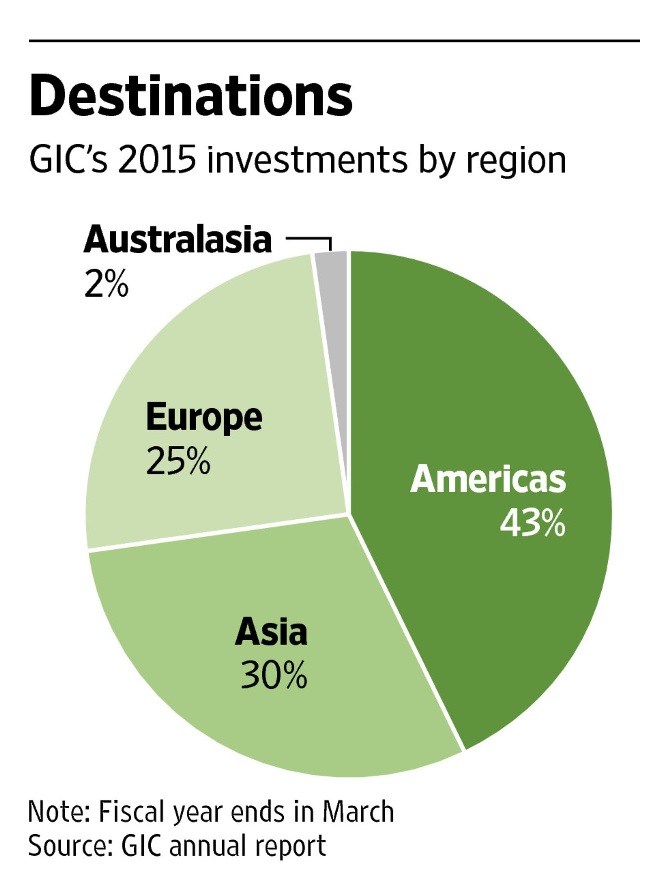
GIC Pte Ltd., whose largest investments are in North America, said ultralow interest rates have inflated asset prices in developed markets. It said opportunities remained in developed and emerging markets, although it cut its exposure to Europe during Q12015.

“The fall in interest rates to historic lows in most advanced economies has caused prices of a broad range of asset classes to rise,” Lim Chow Kiat, GIC’s group president and chief investment officer, said in the fund’s annual report for the fiscal year that ended in March. “The sharp rise of asset prices, when the global economy is still struggling to gain a firm foothold, makes the investment environment particularly uncertain and unpredictable.”

Even China, which has faced waves of heavy selling in stocks in the past month, remains a long-term investment destination for the fund, GIC said. The fund said it still has a positive view on the economy and believed in the ability of the government to carry out overhauls. Recent volatility is ”fallout of rampant market speculation,” Mr. Lim said.

“China in the last three years has demonstrated its seriousness to reforms and we believe that the country’s future is good," he said.

GIC publishes its annual report following a lengthy audit process. The sovereign-wealth fund is a major global player, and its investments are closely watched. The fund said its investments globally gave it a 4.9% 20-year real rate of return for the fiscal year that ended March 31, or a 6.1% return over the same period in U.S. dollar terms.

_____________________________________________
Clicking the Like button on various social media platforms, such as LinkedIn, Facebook, etc. does not constitute a testimonial for or endorsement of Redmount Capital Partners LLC or any Investment Advisor Representative. “Like” is not meant in the traditional sense. Posts must refrain from recommending investment advisory services or providing testimonials for our firm, since they are strictly prohibited. Please understand that we are required to delete such posts, since this is a regulatory requirement.

Sunday, March 29, 2015

Are property valuations chasing future rent increases?

First, let pictures (charts in this case) speak their 1,000 words. 
Commercial property market valuations, in almost all categories, have eclipsed 2006-2007 picks. 

Valuations are even higher in key markets like Tri-State, Boston, Washington DC, Southern California and San Francisco.
" Capitalization rates have dropped to historical lows of 3% to 4% for industrial and multifamily deals in particular." Orange County Business Journal wrote on March 16, 2015.

Yet the largest and most sophisticated investors, led by pension funds, private equity funds, and insurance companies, are in the midst of buying spree.

The rational on the part of buyers? Potential rent increases in the near future. It seems the largest aggregators of capital believe in the continuing economic growth.