Showing posts with label Endowments. Show all posts

Tuesday, December 8, 2015

Emerging Markets: The Fundamental Divergence

While the US dollar appreciation and sharp drop in commodity prices since mid-2014 have been the reasons for our negative stance on emerging market producers throughout the past year, the second round of commodity price decline experienced during the past quarter, alongside Chinese cyclical weakness, has brought about a more generalized negative sentiment on all emerging economies, regardless of their fundamentals.

In a nutshell
  • The fundamental divide between consumer and commodity producing countries is still in place – favor Asia.
  • India looks particularly well positioned, both structurally and from a cyclical perspective.
  • Brazil’s woes are not just oil-related, and point to a lengthy recession.
The recent contagion should not mask the wide divergences that remain between emerging countries. We hold to our view that caution and selectivity are warranted. Indeed, while Latin American countries and Russia continue to suffer from their dependence to commodity prices, as demonstrated by collapsing currencies and contracting industrial production growth, emerging Asia is faring much better, with industrial production still growing at a healthy pace. In other terms, despite the increased fragility of the emerging world at large, the divide between consumer and commodity producing countries remains. So long, of course, that we are correct in assuming a Chinese stabilisation – within its secular downtrend.

For now, many thus maintain our long-held preference for Asian countries. As a whole, the region still boasts solid fundamentals with an expected 2015 current account surplus of 2% (International Monetary Fund (IMF) data) and controlled inflation levels (except in Indonesia) allowing for pro-growth monetary policies. India’s long-term story also remains extremely positive, as long as supply-side reforms do not disappoint, with a fast growing and young middle class. Cyclically, as a net importer, India is a major beneficiary of the fall in commodity prices, which has also helped control historically high inflation levels, allowing the central bank to adopt an expansionary monetary policy.

On the other side of the spectrum, many remain negative on Russia, South Africa and most Latin American countries. Russia’s dependence on oil has brought about a vicious circle of falling currency, high inflation, tight monetary policy and contracting growth. Although, even though oil broke below $40, most expect oil prices to rebound to our long-held USD 50-70 range, this should not prove enough for Russia to break out of the vicious spiral anytime soon. With a large external deficit, high inflation and falling currency, South Africa remains vulnerable to capital outflows. Finally, within Latin America, indeed emerging economies as a whole, Brazil is our biggest concern. The issues there seem to have intensified rather than stabilized over the past few months. A broader collapse of Brazil, which represents some 3% of world GDP (roughly the size of France or Italy), would be particularly worrisome, not only for the region but also for already fragile global growth.

How concerned should we be about Brazil?

Like Russia, Brazil is trapped in a vicious spiral of collapsing currency, skyrocketing inflation, tight monetary policy and deepening recession. The oil price drop did exacerbate Brazil’s woes, but it is not their underlying cause. The country’s fundamentals had already been eroding for some 10 years, as evidenced by a deteriorating current account and lax fiscal policy – even as commodity prices were booming.

Most see three major risks for Brazil. The first is political: Dilma Rousseff’s growing unpopularity means that she has no capital to drive fiscal reforms. An impeachment could in theory allow for a more credible leader to take the reins, but it would also lead to a period of high uncertainty. The second risk stems from China: Brazil would be severely hurt by a hard landing of its main trading partner. The third risk is fiscal: while sovereign default is unlikely in our view given the low level of US dollar-denominated debt, private debt is also growing fast.

All told, many expect Brazil to remain in recession for some time and its currency to stay weak, which will eventually become a support. In terms of our global economic scenario, assuming that China, the US dollar and commodity prices do stabilize, Brazilian issues should not have a systemic impact.

__________

Clicking the Like button on various social media platforms, such as LinkedIn, Facebook, etc. does not constitute a testimonial for or endorsement of Redmount Capital Partners LLC or any Investment Advisor Representative. “Like” is not meant in the traditional sense. Posts must refrain from recommending investment advisory services or providing testimonials for our firm, since they are strictly prohibited. Please understand that we are required to delete such posts, since this is a regulatory requirement.

Thursday, August 13, 2015

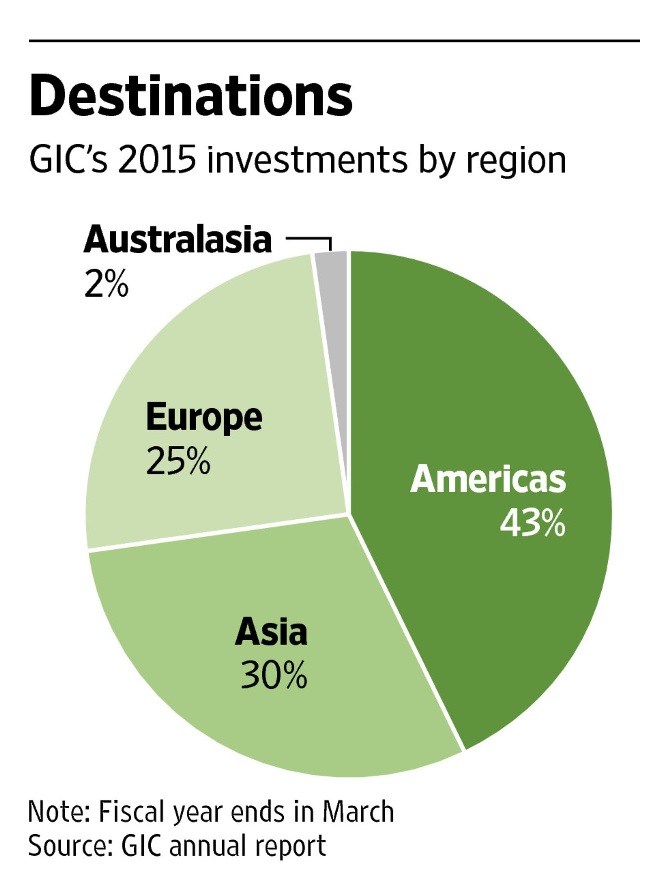
Singapore’s sovereign-wealth fund has warned that it expects lower returns over the next five to ten years

Singapore’s sovereign-wealth fund, one of the world’s biggest and most sophisticated investors, has warned that it expects lower returns over the next five to ten years because global economic growth and earnings don’t look promising.

GIC Pte Ltd., whose largest investments are in North America, said ultralow interest rates have inflated asset prices in developed markets. It said opportunities remained in developed and emerging markets, although it cut its exposure to Europe during Q12015.

“The fall in interest rates to historic lows in most advanced economies has caused prices of a broad range of asset classes to rise,” Lim Chow Kiat, GIC’s group president and chief investment officer, said in the fund’s annual report for the fiscal year that ended in March. “The sharp rise of asset prices, when the global economy is still struggling to gain a firm foothold, makes the investment environment particularly uncertain and unpredictable.”

Even China, which has faced waves of heavy selling in stocks in the past month, remains a long-term investment destination for the fund, GIC said. The fund said it still has a positive view on the economy and believed in the ability of the government to carry out overhauls. Recent volatility is ”fallout of rampant market speculation,” Mr. Lim said.

“China in the last three years has demonstrated its seriousness to reforms and we believe that the country’s future is good," he said.

GIC publishes its annual report following a lengthy audit process. The sovereign-wealth fund is a major global player, and its investments are closely watched. The fund said its investments globally gave it a 4.9% 20-year real rate of return for the fiscal year that ended March 31, or a 6.1% return over the same period in U.S. dollar terms.

_____________________________________________
Clicking the Like button on various social media platforms, such as LinkedIn, Facebook, etc. does not constitute a testimonial for or endorsement of Redmount Capital Partners LLC or any Investment Advisor Representative. “Like” is not meant in the traditional sense. Posts must refrain from recommending investment advisory services or providing testimonials for our firm, since they are strictly prohibited. Please understand that we are required to delete such posts, since this is a regulatory requirement.

Monday, February 9, 2015

Asset allocation of endowments

Endowments and sovereign wealth funds are expected to invest with the longest time horizon and view.

The chart sums up latest disclosures of investment holdings by endowments and Corporate Pension Funds.

The first observable fact: low level of lack of fixed income in endowment portfolios, 9.00%.

Second, 53.7% of endowment holdings are in "alternative" classes: hedge funds, private equity, and real estate.

Equities are only 27.00% of endowment portfolios.

Alternatives investments, offering lower liquidity and lower volatility, are not so "alternative" for endowments, who are assuming that returns will be better from hedge funds, private equity, and real estate.

As a result, almost 99% of endowments expect better than 7% annualized returns over the long run, while only 66% of pension funds expect the same.

Source: Market Insights. 1Q 2015. JP Morgan Asset Management.