Showing posts with label Equities. Show all posts

Thursday, August 13, 2015

Singapore’s sovereign-wealth fund has warned that it expects lower returns over the next five to ten years

Singapore’s sovereign-wealth fund, one of the world’s biggest and most sophisticated investors, has warned that it expects lower returns over the next five to ten years because global economic growth and earnings don’t look promising.

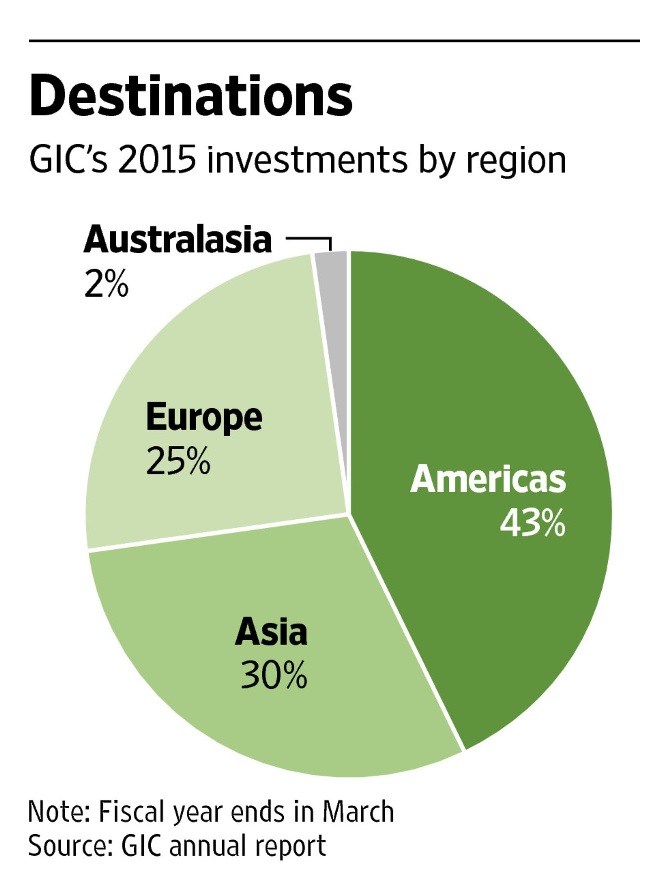
GIC Pte Ltd., whose largest investments are in North America, said ultralow interest rates have inflated asset prices in developed markets. It said opportunities remained in developed and emerging markets, although it cut its exposure to Europe during Q12015.

“The fall in interest rates to historic lows in most advanced economies has caused prices of a broad range of asset classes to rise,” Lim Chow Kiat, GIC’s group president and chief investment officer, said in the fund’s annual report for the fiscal year that ended in March. “The sharp rise of asset prices, when the global economy is still struggling to gain a firm foothold, makes the investment environment particularly uncertain and unpredictable.”

Even China, which has faced waves of heavy selling in stocks in the past month, remains a long-term investment destination for the fund, GIC said. The fund said it still has a positive view on the economy and believed in the ability of the government to carry out overhauls. Recent volatility is ”fallout of rampant market speculation,” Mr. Lim said.

“China in the last three years has demonstrated its seriousness to reforms and we believe that the country’s future is good," he said.

GIC publishes its annual report following a lengthy audit process. The sovereign-wealth fund is a major global player, and its investments are closely watched. The fund said its investments globally gave it a 4.9% 20-year real rate of return for the fiscal year that ended March 31, or a 6.1% return over the same period in U.S. dollar terms.

_____________________________________________
Clicking the Like button on various social media platforms, such as LinkedIn, Facebook, etc. does not constitute a testimonial for or endorsement of Redmount Capital Partners LLC or any Investment Advisor Representative. “Like” is not meant in the traditional sense. Posts must refrain from recommending investment advisory services or providing testimonials for our firm, since they are strictly prohibited. Please understand that we are required to delete such posts, since this is a regulatory requirement.
Monday, August 3, 2015

Global Economic Environment at the Half-year Mark of 2015

US
Starting with the US economy, which began the year on the wrong foot, we believe the weakness of the first quarter is temporary in nature, mostly due to exceptional factors. US GDP is reported to have contracted by 0.2% in Q1, though there could be revisions to this estimate. The pace of activity was held back by harsh winter conditions, disruptions to ports on the West Coast, reduced energy investment following the decline in oil prices (which subtracted about 0.5 percentage points from Q1 growth), and weaker exports held back by a stronger dollar. Moreover, seasonal adjustment techniques in the official statistics have resulted in Q1 growth systematically reported as much lower than the full-year average.

Both oil prices and the dollar have stabilized; as a consequence, the supply adjustment in energy markets has decelerated: The number of rigs in operation continues to decline but at a much slower pace, and the drag on exports (equivalent to about 0.6 percentage points for every 10% real appreciation) should have largely run its course. Meanwhile, the labor market continues to improve, with new job creation in the non-farm sector running at a 3-month average of about 200,000; the unemployment rate has declined to 5.3%, close to the Congressional Budget Office’s estimate of the non-accelerating inflation rate of unemployment (NAIRU). 

A tighter labor market has begun to exert pressure on wages. The Employment Cost Index accelerated to 2.6% year-over-year in Q1, the highest pace since 2008; wages and salaries were up 5.0% year-over-year in May. Core inflation has remained stable at close to 1.5%; the base effects from lower oil prices will begin to fade by August, and the recent pickup in oil prices will then gradually push headline inflation closer to core; wage pressures are then likely to translate into more significant price increases over the remainder of the year and into 2016. 

Overall, these data make us confident that the US recovery remains on track. This in turn should lead the Fed to hike interest rates later this year, most likely in late Q3 or in Q4. Financial markets have begun to anticipate the likely move, with 10-year Treasury bond yields rising from about 1.64% at the end of January to about 2.35% by the end of June. Markets are, however, pricing a slower pace of monetary policy tightening than the Fed itself has indicated. While the central bank will likely start tightening at a slow pace, it might need to move faster once inflation pressures build up; this would imply an even larger disconnect from current market expectations. 

Europe
Eurozone growth has surprised on the upside in Q1, as we had predicted in our previous Global Macro Shifts publication. At +0.4%, Q1 marked the 8th consecutive quarter of positive quarterover-quarter (qoq) growth. The pickup in economic activity has been spurred, most importantly, by a weaker euro, which has boosted the competitiveness of eurozone exporters. QE by the European Central Bank (ECB) also helped, by reducing funding costs and pushing more liquidity into the banking system. Recent indicators suggest that positive momentum persists: Purchasing manufacturers index, retail sales and lending indicators all remain on an uptrend. 

Though most of the eurozone has seen a broad-based pickup in activity, the sustainability of this varies across countries. Spain, for example, has been outperforming on the back of its reforms and the efforts made to put public finances on a sounder footing. Germany maintains strong international competitiveness, currently buttressed by a healthier domestic demand. Germany’s trade surplus runs at about 7% of GDP, proof of its enduring export prowess. In France and Italy, however, the acceleration seems more cyclical in nature; both countries need a more determined reform effort to accelerate growth on a more sustainable basis. 

The recently launched QE program has successfully begun inverting the previous contraction of the ECB’s balance sheet, which shrank by as much as one third from its peak. Together with existing programs for the purchase of covered bonds and ABS,1 QE has boosted the central bank’s balance sheet by about €200 billion (bn), compared to a target of about €1.1 trillion (tn) as of June 30. Some analysts and market players have speculated that the ECB might abandon its QE program in the near future, given the stronger-than-expected pace of growth. ECB President Mario Draghi, however, has repeatedly emphasized that the bank intends to carry out its program at least until September 2016, and that in any event it would need convincing evidence that inflation is converging to its 2% target in a sustainable way before considering a policy change. 

The Greek saga remains the main cloud on the horizon of the European recovery. Greek voters rejected the latest creditors’ proposal in a referendum held on July 5. The referendum asked voters to either accept or reject the latest economic program that resulted from six months of difficult negotiations with the European Union, ECB and International Monetary Fund (IMF). Eurozone leaders had warned that a “no” vote would most likely result in Greece exiting the eurozone. While negotiations are expected to resume, the risk of “Grexit” has substantially increased. Rather than predicting the outcome of these discussions, we prefer to focus on the possible consequences of the worst-case scenario. Should Greece leave the euro, we believe this would cause a temporary shock to financial markets, with peripheral spreads widening in the eurozone, and a spike in global risk aversion. We are also confident that the eurozone’s current firewalls are strong enough to limit contagion, so that the adverse impact should be limited and temporary in scope. 

Japan 
Japan appears to be finally succeeding in its struggle against deflation. Core CPI is running at about 2%, even subtracting the impact of tax hikes. Even the collapse in oil prices has not been enough to push the country back into deflation, and nominal GDP growth remains on a healthy uptrend. Japan’s success in keeping inflation in positive territory is especially remarkable given the extremely adverse external environment, where many countries have experienced deflationary pressures. This constitutes very encouraging evidence that the “first arrow” of Abenomics, namely a much more decisive QE push, has proved effective. 

The positive impact of Abenomics can be seen on output growth: GDP expanded faster than expected in Q1, at over a 2% qoq seasonally adjusted annualized rate. Inventory accumulation played an important role, but there were also encouraging signs of a rebound in both private consumption and capital expenditures. Moreover, output prices have been running significantly above input prices, indicating that profitability will likely improve, which would support the outlook for a further pickup in investment. Last year’s tax hike, therefore, has not stopped the recovery, contrary to what a number of analysts feared, especially given that a tax hike derailed Japan’s attempt to exit deflation in 1997. This tax hike, the cornerstone of the fiscal strategy, therefore, was a calculated but courageous gamble—and has paid off. This should be considered as another major success of the government’s policy: The “second arrow,” a prudent fiscal policy, promotes confidence in long-term debt sustainability. 

The “third arrow,” structural reforms, remains the most important part of the equation—and has been the focus of most questions and skepticism since the launch of Abenomics. In this area, some important progress has already been made. On the financial side, the portfolio rebalancing of the Government Pension Investment Fund has begun spilling over to other institutions, such as Japan Post and the public employees’ pension funds. Probably more important are efforts to strengthen corporate governance through improving transparency and encouraging a more active role by shareholders and corporate boards. 

Japan’s productivity, after running at about 3% in the 1980s and about 2% in the 1990s, now languishes at a mere 1%. Weak corporate management practices and the ensuing inefficiencies are the main culprits for this productivity slowdown. Japan must boost nominal GDP growth on a durable basis to guarantee the sustainability of its massive debt burden. Besides a permanent rise in the inflation rate, this requires stronger overall real GDP growth. This must be achieved in the face of intensifying demographic pressures, as Japan’s population will continue to age rapidly in the coming decades. Government programs to boost the labor force, in particular by raising female participation, can help, but will not fully offset the impact of aging. To achieve stronger real GDP growth therefore, Japan must achieve faster productivity growth, importantly requiring a strengthening of corporate governance. Japan has therefore adopted a new corporate governance code, which formalizes explicit responsibilities for corporate boards to scrutinize management and communicate information to shareholders, and requires every board to have at least two external directors. Much more work will be needed to increase flexibility and boost productivity, but the measures already taken confirm that the government realizes that it must attempt to tackle the toughest reforms, even if this means clashing with powerful vested interests.

_____________________________________________
Clicking the Like button on various social media platforms, such as LinkedIn, Facebook, etc. does not constitute a testimonial for or endorsement of Redmount Capital Partners LLC or any Investment Advisor Representative. “Like” is not meant in the traditional sense. Posts must refrain from recommending investment advisory services or providing testimonials for our firm, since they are strictly prohibited. Please understand that we are required to delete such posts, since this is a regulatory requirement.

Wednesday, July 15, 2015

Investment strategy - Asset Management, 2nd quarter 2015

Deflationary pressures – and the associated risks to growth – are the common enemy faced by most economies across the globe.

At a glance
  • Deflationary pressures – and the associated risks to growth – are the common enemy faced by most economies across the globe. They are the motive behind the ongoing global easing cycle.
  • A stronger US dollar and the resulting foreign exchange market volatility argue for greater differentiation amongst portfolios, in accordance with their reference currency. Hedging has become a must.
  • Euro area investors will benefit from both liquidity injections and the materializing economic recovery – a positive outlook that supports our preference for risky assets over cash.
  • A more balanced approach is required when it comes to US dollar- and Non-US dollar- based portfolios, given the more limited equity market upside.
  • External debt levels and commodity intensity are dividing the emerging economies into two camps: those who can afford to loosen monetary policy (Asia) and those who are forced to keep rates high (Russia, Brazil).
_____________________________________________
Clicking the Like button on various social media platforms, such as LinkedIn, Facebook, etc. does not constitute a testimonial for or endorsement of Redmount Capital Partners LLC or any Investment Advisor Representative. “Like” is not meant in the traditional sense. Posts must refrain from recommending investment advisory services or providing testimonials for our firm, since they are strictly prohibited. Please understand that we are required to delete such posts, since this is a regulatory requirement.

Thursday, June 18, 2015

May June 2015 Market Observations

The US equity markets continue their advance 
• The S&P 500 returned 1.3% for the month. Small cap led the advance. 
• Growth outperformed value in the small and large cap segments. Value outperformed growth in the mid cap segment. 
• Health care and technology were the top performing sectors in the small, mid and large cap segments, supporting the growth indices. The energy sector was the worst performing sector with negative returns, dragging down the value indices. 
• Real assets such as MLPs, REITs and infrastructure were negative performers for the month. 
• Price momentum and Growth factors were the best performing. Quality and value factors were weaker but still positive. 

Weak performance in international and emerging markets for the month 
• International equities, as reflected by the MSCI EAFE Index, finished the month with a return of -0.5% in USD terms, underperforming the US market. Japan outperformed Europe as per the MSCI Japan Index return of 5.0% versus the MSCI Europe Index which returned -0.8% in USD terms. 
• Emerging markets, as reflected by MSCI EM Index, returned -4.0% for the month in USD terms. EM Eastern Europe and Latin America were the worst performing EM regions. 
• The energy sector was the weakest performing in both non-US developed and emerging markets. 
• Price momentum was clearly the top performing factor in developed markets. Quality was the top performing factor in emerging markets. The weakest performing factors were value in both developed and emerging markets. 

High yield credit was lone bright spot in fixed income 
• High yield credit was the best performing fixed income segment for the month. Only high yield, leveraged loans and short duration Treasuries posted positive returns (with the exception of CCC-rated credit, which was slightly down for the month). 
• Long duration Treasuries was the worst performing fixed income segment followed by investment grade credit. 
• Most major currencies depreciated relative to the US dollar during the month. The main exception was the Renminbi. 
• Currency depreciation hurt the performance of non-dollar bonds after a strong month in April.

Market information source: Bloomberg.

_____________________________________________
Clicking the Like button on various social media platforms, such as LinkedIn, Facebook, etc. does not constitute a testimonial for or endorsement of Redmount Capital Partners LLC or any Investment Advisor Representative. “Like” is not meant in the traditional sense. Posts must refrain from recommending investment advisory services or providing testimonials for our firm, since they are strictly prohibited. Please understand that we are required to delete such posts, since this is a regulatory requirement.

Tuesday, May 12, 2015

U.S. cash balances remain high


Investors are continuing to hoard cash and keep more and more capital in short-term assets.

Source: Investment Company Institute data, Federal Reserve, and Bloomberg. *Total cash and short-term assets include money market assets (ICI), large time deposits, all commercial banks, NSA (not seasonally adjusted), savings deposits, and small time deposits.

_____________________________________________
Clicking the Like button on various social media platforms, such as LinkedIn, Facebook, etc. does not constitute a testimonial for or endorsement of Redmount Capital Partners LLC or any Investment Advisor Representative. “Like” is not meant in the traditional sense. Posts must refrain from recommending investment advisory services or providing testimonials for our firm, since they are strictly prohibited. Please understand that we are required to delete such posts, since this is a regulatory requirement.


Thursday, May 7, 2015

FAQs on Greek debt default

Today European Central Bank gave Greece another week to make a deal or tighter liquidity rules will be imposed on its banks. And this is just a start.

The summer of 2015 will bring renewed drama around Greek debt and potential default, Greece has to come up with about 4 billion euros ($4.5 billion) by the end of May for debt payments. Then there’s the 1.5 billion-euro monthly tab for salaries and pensions.

As Prime Minister Alexis Tsipras’s government in Athens haggles over the details of its reforms and leans on its banks to keep buying Treasury bills, the question inevitably looms: what happens if the cash runs out?

Not all creditors are created equal. For example, the International Monetary Fund is more equal than others, first in the repayment queue.

We found the Q&A session conducted by Bloomberg View Columnist Mark Gilbert with Mizuho International Chief European Economist Riccardo Barbieri to be of great value for frequently asked questions (FAQs) related to Greek debt, its potential default, and the probable processes triggered by a default.

Here are the key Q&As for your review.

Q: What is a default?
A: Investopedia.com defines default as “the failure to promptly pay interest or principal when due. Default occurs when a debtor is unable to meet the legal obligation of debt repayment.”

Q: How much debt does Greece have?
A: The Greek government has about 313 billion euros of debt outstanding, most due after 2021. Add companies and banks and the total is closer to half a trillion. Given that Greek banks are likely to refinance most of the maturing Treasury bills without protest -- with pension funds and local governments making up the shortfall -- the important near-term deadlines are May 6 and May 12, when the IMF is due to receive almost 1 billion euros in total. The real crunch comes midyear, when almost 7 billion euros of bonds held by the European Central Bank mature in July and August.

Q: What happens if the IMF isn’t paid?
A: A missed payment date starts the clock ticking. Two weeks after the initial due date and a cable from Washington urging immediate payment, the fund sends another cable stressing the “seriousness of the failure to meet obligations” and again urges prompt settlement. Two weeks after that, the managing director informs the Executive Board that an obligation is overdue. For Greece, that’s when the serious consequences kick in. These are known as cross-default and cross-acceleration.

Q: What are cross-default and cross-acceleration?
A: Failure to pay the IMF would entitle some of Greece’s other creditors, including the European bailout fund, to declare a default. They would then have the option to demand immediate repayment of all their loans, a process known as acceleration. Other lenders could then follow suit. While calling a default preserves creditors’ claims, acceleration -- the bit that hurts -- isn’t automatic. Each creditor decides on its own. To varying degrees the debt is linked in a web of cross-default and cross-acceleration clauses that make it safe to assume that one default and acceleration would trigger demands for repayment on most, if not all, of the rest. Greek debt features a variety of structures, with different terms and conditions and governed principally by Greek and English law. The obligations include bonds whose holders voted not to take part in a 2012 restructuring; notes issued in that restructuring; bonds held by the ECB; a series of loans from Europe’s bailout fund, including one used to sweeten the restructuring pill; notes issued last year; the 2010 Greek Loan Facility; and the IMF loans.

Q: What about credit-default swaps?
A: The determinations committee of the International Swaps & Derivatives Association, the trade association that administers derivative contracts, must first receive a request for a ruling on what should happen to CDS contracts. It then makes a binding decision on whether a “credit event” has occurred, which may trigger the contracts. There are now 622 contracts open, covering a net $592 million, according to Depository Trust & Clearing Corp., which runs a data warehouse. In 2012, the contracts paid out after the country’s debt restructuring, which was the biggest ever.

Q: What would default do to Greek banks?
A: That depends on the attitude of the ECB and on the default itself. With lenders losing deposits, only a drip-feed of Emergency Liquidity Assistance supplied by the Bank of Greece against deteriorating collateral is keeping them afloat. While ECB President Mario Draghi indicated last week that ELA would continue as long as the lenders are solvent and have adequate collateral, bank solvency, especially of lenders using ELA, is very much a judgement call, says Gabriel Sterne, head of global macro research at Oxford Economics in London. Failure to repay the ECB in July and August would probably result in the suspension of ELA, according to Chris Attfield, a strategist at HSBC Holdings Plc in London. Any interruption in ELA would almost certainly trigger a fully fledged bank run, forcing the imposition of capital controls. If the banks themselves are victims of the default after, say, a failed Treasury bill auction, then their insolvency would probably ensue and ELA would end.

Q: How would capital controls work?
A: In Greece, not so well. Unlike the island of Cyprus, which this year lifted controls implemented two years ago, Greece has porous borders and mobile citizens. While controls would stop capital flight via the banks, there is still the cash residents have withdrawn.

Q: We hear a lot about Target2. What’s that?
A: It’s the payment system established by the ECB that allows euros created by each national central bank to flow freely in the 19-nation currency bloc. In 2013, an average 1.9 trillion euros of transactions per day were processed, according to the ECB website. It also keeps track of who owes what to whom and at the end of March, Greece was in the hole to its partners for 96 billion euros, or more than 40 percent of economic output, according to the Bank of Greece. Courtesy of Target2, money created in Athens is circulating in Paris and Berlin after paying for Peugeot cars and Bayer AG’s asprin. As long as Greece remains officially in the euro zone -- even if a parallel currency circulates -- the nation’s Target2 liabilities are a political concern, not a financial one. However, loss of access to Target2 “would crystallize the liability,” said John Whittaker, a fellow of Lancaster University Management School who has published on European payment systems. “The other central banks would then have losses in proportion to their share of the ECB’s capital.”

Q: What about Greek companies?
A: A sovereign default would probably be followed by corporate defaults. Greek assets overseas would be fair game for creditors, though there aren’t many to grab. The former Coca-Cola Hellenic Bottling Co., the world’s second-largest Coca-Cola bottler, for example, is now called Coca-Cola HBC AG and is headquartered in Switzerland. Also, capital controls would probably be accompanied by other measures, such as orders for companies to repatriate euros held overseas and prohibitions on dividend payments. The government might also introduce IOUs to substitute the missing euros -- in 2010 it slashed the price it would pay drug suppliers and then paid them with bonds.

Q: Could Greece default and remain in the euro?
A: Exiting the euro would only be possible if Greece left the European Union, according to Yannis Manuelides at Allen & Overy. “The euro is an integral part of the union and it’s meant to be a one-way street,” he said. “There is no way to expel a member and to allow or force an exit would be very bad for the EU. They will do everything they can to avoid it.” That may not be enough: According to Benedict James, a banking partner at Linklaters, capital controls would be “a staging post to an exit.” James agrees that the only way for Greece to leave the euro would be to exit the EU altogether. In sum, Greece leaving the euro is likely to be messy, lengthy and painful for all concerned, with the Greeks suffering more than their partners and the lawyers profiting. The real deadline is in June, when national parliaments start to head off for the summer break, said Zsolt Darvas, a fellow at the Bruegel think tank in Brussels who reckons that Greece will be able to scrape by for now.

_____________________________________________
Clicking the Like button on various social media platforms, such as LinkedIn, Facebook, etc. does not constitute a testimonial for or endorsement of Redmount Capital Partners LLC or any Investment Advisor Representative. “Like” is not meant in the traditional sense. Posts must refrain from recommending investment advisory services or providing testimonials for our firm, since they are strictly prohibited. Please understand that we are required to delete such posts, since this is a regulatory requirement.

Thursday, April 30, 2015

Is the Corporate M&A Bubble in Trouble?

We think its not...yet. The current level of activity suggests that corporate managers will continue to buy rather than build.

In a recent CNBC poll, some 56% of companies said that they plan an acquisition in the coming year, up from 40% last October and the first time since 2010 that more than half plan to do something. But even if such plans were to generate a surge later this year, it would make a bullish argument for equities, not the bearish one accompanying much of this recent buzz.

M&A, quite simply, is a vote of confidence in market values and the future generally. Companies buy each other when they see a reason to expand and when other firms look attractively cheap. The same goes for private equity, which is no less in the acquisition business than corporations. If these decision makers saw stocks as expensive, they would pursue their expansion with direct investments in new equipment, premises, and in a hiring program. Since they are buying these days and doing relatively little building, they have effectively announced that stock values still make a purchase the more attractive way to expand.

Table 1. M&A Activity (monthly rates)
Period
Number of Deals
Value ($ in bil.)
2013 4Q
817
$79.6
2014 1Q
959
$108.7
         2Q
1,000
 154.8
         3Q
1,003
 108.1
October
1,123
 96.5
November
1,006
 194.0
December
983
 103.6
2015 January
995
$78.4
        February
938
114.3

Source: FactSet

_____________________________________________

Clicking the Like button on various social media platforms, such as LinkedIn, Facebook, etc. does not constitute a testimonial for or endorsement of Redmount Capital Partners LLC or any Investment Advisor Representative. “Like” is not meant in the traditional sense. Posts must refrain from recommending investment advisory services or providing testimonials for our firm, since they are strictly prohibited. Please understand that we are required to delete such posts, since this is a regulatory requirement.

Tuesday, April 28, 2015

Top geopolitical risks to watch for

Synopsis of Eurasia Group's Top Risks 2015 

1 - The Politics of Europe
Europe's economics are in substantially better shape than at the height of the Eurozone crisis. But the politics is now much worse. That's true on three different levels: bottom-up, intra-EU, and outside-in.

2 - Russia
Last year, we highlighted Russia as one of the top risks to global security--that was before Moscow carried out the most brazen redrawing of European borders since World War II, and then fell into a severe currency crisis. The conflict with the West over Ukraine has crystallized a newly aggressive and explicitly anti-Western Russian foreign policy. Western sanctions, a sagging oil price, economic stagnation, and the ruble's plunge are weakening Russia economically and financially, though not driving it to the point of crisis. 

3 - The Effects of China Slowdown
We're quite optimistic about China this coming year. President Xi Jinping has consolidated an extraordinary amount of power since ascending to the presidency. He has launched policies long overdue to rebalance the economy, pushing ahead on improving air quality, pursuing a series of measures aimed at making state-owned enterprises more efficient and spearheading a massive anticorruption campaign within the Communist Party.

4 - Weaponization of Finance
The United States remains the world's only superpower, but Washington is now using its influence in important new ways. After World War II, American dominance was established by the forging of us-led alliances such as NATO and multilateral institutions such as the IMF and the World Bank that enshrined US-authored rules and standards.

5 - ISIS, Beyond Iraq and Syria

In 2015, ISIS faces setbacks in its core bases in Iraq and Syria, but its military power remains significant, and its ideological reach will spread throughout the Middle East and North Africa. It will grow organically by setting up new units in Yemen, Jordan, and Saudi Arabia, and it will inspire many jihadist organizations to join its ranks. Ansar Bayt al Maqdas in Egypt and Islamists in the Libyan city of Derna have already pledged allegiance to ISIS leader Abu Bakr al Baghdadi.

6 - Weak Incumbents
Political risk stemming from weak incumbents who recently won reelection will weigh on key markets in 2015. With the important exceptions of India and Indonesia, the wave of emerging market elections in 2014 saw incumbents win underwhelming victories. Sluggish growth and mounting popular demands were not enough to displace ruling party candidates in Brazil, Colombia, South Africa, and Turkey, and are unlikely to do so in Nigeria in 2015.

7 - The Rise of Strategic Sectors
In 2015, success and failure for business will depend increasingly on governments. For decades, the perception was that multinational companies were developing greater autonomy from policymakers, both in their home governments and in the countries where they operate, eroding state authority to regulate the flow of goods and services around the world. Instead, government influence is expanding, focused more on political stability than on economic growth.

8 - Saudi Arabia vs. Iran
Saudi-Iran tensions will spike during 2015, worsening the Sunni-Shia sectarian rift across the region.
The relationship will be especially volatile this year because: 1) there will be an unprecedented number of theaters of proxy conflict 2) domestic politics in both countries will enhance conflict and 3) the evolution of diplomacy on Iran's nuclear program, regardless of the outcome, will provoke more strife between Riyadh and Tehran. 

9 - Taiwan/China
Relations between China and Taiwan will deteriorate sharply in 2015 following the opposition Democratic Progressive Party's (DPP's) landslide victory over the ruling nationalist party in November's local elections. Taiwan's political class will focus overwhelmingly this year on throwing elbows at one another ahead of the 2016 presidential election. President Ma Ying-Jeou is already a lame duck, and we expect no progress toward an agreement with China on any form of trade liberalization.

10 - Turkey
For the second year in a row, Turkey makes our list. Lower oil prices have been good news for this country, but that's about all that's going well. Heavy-handed rule, short-sighted political decisions, and bad foreign policy bets will all conspire against Turkey. At home, Erdogan has used election victories in 2014 to ensure decisive defeat of his political enemies (of which there are many) while remaking the country's political system to tighten his hold on power.

Red Hearing 1 - Asia Nationalism
Red Hearing 2 - The Islamic State
Red Hearing 3 - Petrostates
Red Hearing 4 - Mexico

_____________________________________________
Clicking the Like button on various social media platforms, such as LinkedIn, Facebook, etc. does not constitute a testimonial for or endorsement of Redmount Capital Partners LLC or any Investment Advisor Representative. “Like” is not meant in the traditional sense. Posts must refrain from recommending investment advisory services or providing testimonials for our firm, since they are strictly prohibited. Please understand that we are required to delete such posts, since this is a regulatory requirement.

Thursday, April 16, 2015

The effects of bulging corporate purses.


High cash levels, accumulated by S&P 500 corporations, are being put to work. Above charts are showing growing levels of capital expenditures, M&A activities, dividends, and stock buybacks by the nation's largest corporations.

If sustainable, this will benefit the economy. Capital expenditures can add to the industrial growth. Dividends and stock buybacks will probably add to consumer spending and housing sector strength. Corporate mergers and acquisition activities may strengthen equity markets.

_____________________________________________
Clicking the Like button on various social media platforms, such as LinkedIn, Facebook, etc. does not constitute a testimonial for or endorsement of Redmount Capital Partners LLC or any Investment Advisor Representative. “Like” is not meant in the traditional sense. Posts must refrain from recommending investment advisory services or providing testimonials for our firm, since they are strictly prohibited. Please understand that we are required to delete such posts, since this is a regulatory requirement.


Monday, April 13, 2015

Factors shaping investment markets. April 2015.


Deflationary pressures – and the associated risks to growth – are the common enemy faced by most economies across the globe. They are the motive behind the ongoing global easing cycle.

A stronger U.S. dollar and the resulting foreign exchange market volatility argue for greater differentiation amongst portfolios, in accordance with their reference currency. Hedging has become a must.

Euro markets will benefit from both liquidity injections and the materializing economic recovery – a positive outlook that supports our preference for risky assets over cash.

A more balanced approach is required when it comes to U.S. dollar- and Swiss franc-based portfolios, given the more limited equity market upside.

External debt levels and commodity intensity are dividing the emerging economies into two camps: those who can afford to loosen monetary policy (Asia) and those who are forced to keep rates high (Russia, Brazil).

_____________________________________________
Clicking the Like button on various social media platforms, such as LinkedIn, Facebook, etc. does not constitute a testimonial for or endorsement of Redmount Capital Partners LLC or any Investment Advisor Representative. “Like” is not meant in the traditional sense. Posts must refrain from recommending investment advisory services or providing testimonials for our firm, since they are strictly prohibited. Please understand that we are required to delete such posts, since this is a regulatory requirement.

Friday, March 20, 2015

The Secrets to Valuing Hot Tech Companies.

This week Bloomberg Business shed some light on on this.

The opinion was built around a photo-messaging app raising cash at a $15 billion valuation. Bloomberg Business doubts that this company is actually worth more than Clorox or Campbell Soup and was curious where did investors come up with that enormous headline number?

Here's the secret, Bloomberg thinks, to how Silicon Valley calculates the value of its hottest companies: The numbers are sort of made-up. For the most mature startups, investors agree to grant higher valuations, which help the companies with recruitment and building credibility, in exchange for guarantees that they'll get their money back first if the company goes public or sells. They can also negotiate to receive additional free shares if a subsequent round's valuation is less favorable. Interviews with more than a dozen founders, venture capitalists, and the attorneys who draw up investment contracts reveal the most common financial provisions used in private-market technology deals today.

The backroom agreements are becoming more common as tech companies stay private longer, according to the interviews and financial documents obtained by Bloomberg Business. The practice obfuscates the meaning of a valuation, which can become dangerous down the road because private investors aren't taking the same risks a public-market shareholder would. By the time a company does go public, the valuation it got from VCs may not align with its balance sheet. 

Our own opinion? The above is not exactly a great confidence builder.

_____________________________________________
Clicking the Like button on various social media platforms, such as LinkedIn, Facebook, etc. does not constitute a testimonial for or endorsement of Redmount Capital Partners LLC or any Investment Advisor Representative. “Like” is not meant in the traditional sense. Posts must refrain from recommending investment advisory services or providing testimonials for our firm, since they are strictly prohibited. Please understand that we are required to delete such posts, since this is a regulatory requirement.

Monday, March 2, 2015

Is the deleveraging over?


Economic growth may go into higher gear if U.S. households are finally done deleveraging  There may still be room for more deleveraging as well. These processes may impact inflation, interest rates, commodities, retail and housing activities, equity markets, debt markets, etc.

The charts above (click to enlarge) look at the current state of consumer finances. The chart on the left shows the makeup of the household "balance sheet" and the top right chart shows what percentage of disposable income is spent on debt service, highlighting the consumer deleveraging we have observed over the past few years. The chart on the bottom right looks at household net worth, which is the sum of all assets, including home equity, less all liabilities.

Chart: Market Insights. 1Q 2015. JP Morgan Asset Management

_____________________________________________
Clicking the Like button on various social media platforms, such as LinkedIn, Facebook, etc. does not constitute a testimonial for or endorsement of Redmount Capital Partners LLC or any Investment Advisor Representative. “Like” is not meant in the traditional sense. Posts must refrain from recommending investment advisory services or providing testimonials for our firm, since they are strictly prohibited. Please understand that we are required to delete such posts, since this is a regulatory requirement.

Wednesday, February 18, 2015

Is the fiscal situation in Greece a global threat?

In reality the fiscal situation in Greece is not a global economic threat. Greece is only going through a debt crisis.

To evaluate the matter, it is important to differentiate between the stock of debt and the flow of new debt.

We should not be complacent about the stock of debt: it is high and probably unsustainable at 180% of GDP. Even with higher growth of economy this level of debt would be a challenge. Greece's growth is very low, demographics are unsupportive, productivity is very week. However, we should not forget that Greek debt has already been significantly restructured in such a way that it is manageable in the short-term. Altogether, current high level of Greek debt is a threat to Greece. It will probably impact its creditors as well.

On the other hand, Greek debt flows fundamentals have exceptionally improved, and have been strong. What Greeks did is almost unprecedented. Within five years, they turned their government primary balance to a surplus. Similarly, their current account, over the same period, went from a deficit of 115 to a surplus of over 1%.

So, we have a country that runs a primary budget surplus and a current account surplus, but where, partly because of austerity, there is no growth possible. Hence, the stock of debt crisis only. It can add to market volatility. If poorly handled by Eurozone powers, it can result in Euro weakness. This will hardly result in global economic threat.

Monday, February 9, 2015

Asset allocation of endowments

Endowments and sovereign wealth funds are expected to invest with the longest time horizon and view.

The chart sums up latest disclosures of investment holdings by endowments and Corporate Pension Funds.

The first observable fact: low level of lack of fixed income in endowment portfolios, 9.00%.

Second, 53.7% of endowment holdings are in "alternative" classes: hedge funds, private equity, and real estate.

Equities are only 27.00% of endowment portfolios.

Alternatives investments, offering lower liquidity and lower volatility, are not so "alternative" for endowments, who are assuming that returns will be better from hedge funds, private equity, and real estate.

As a result, almost 99% of endowments expect better than 7% annualized returns over the long run, while only 66% of pension funds expect the same.

Source: Market Insights. 1Q 2015. JP Morgan Asset Management.

Wednesday, February 4, 2015

The Magic in selling a business interest.


Recently the partners of Redmount Capital were at a luncheon with Earvin Magic Johnson delivering a keynote speech.

We were hoping for some insight from Magic, in our mind the most successful pro-athlete entrepreneur, turning his athletic power into business empire. He built best-in-kind connections to propel his business juggernaut. His business visions are not only contrary to the consensus but also ahead of times.

Right away we were made aware that Magic is a genuinely fun person. He is charming yet highly opinionated.  We knew he was competitive but as he spoke we also learned how fond he is of a good competition. It seems he is not only in it to win it but also to get better. All along he was affectionate to the listeners, truly appreciating their interest and presence.

"So should I sell Lakers?"

As he spoke we kept looking for details in his entrepreneurial ways. He let us as he brought up the
sale of his ownership in LA Lakers. Magic acquired interest in to the team in 1994. In 2010 the news
of his LA Lakers sale took many by surprise, Most people thought that he was making a mistake and that he will come to regret it. 

At the luncheon Magic explained why he decided on the sale. LA Lakers were doing as good as they have ever done...or could have ever done. Kobe was getting older. Magic had another plan in the works. He was just looking for the right offer. 

What was his plan? His purchase, in partnership with Guggenheim, of LA Dodgers.

Magic knew Dodgers presented a similar opportunity as Lakers in 1994, only larger. He realized that he needed capital. which he could obtain, if he sold something. He also knew that he needed his focused attention on Dodgers.

Several well-known billionaire investors were ready to partner with him in the Dodgers deal. Choosing the right one seemed easy but he wanted himself to be a large investor in the deal. He wanted to call the shots and make good money.

Prior to that, several offers were received by Magic to consider selling Lakers, but he was looking for the "right offer". He did not elaborate what he thought the "right offer" was. We suspect he knew what it would look like - at a right price and timed to let him get the Dodgers' deal done.

"So should I sell Lakers?" Magic asked us all in the room, extending the microphone towards us. "You guys are smart enough, you have clients like me". "Yes", spoke the group. Magic nodded in satisfaction, with his smile getting brighter.


In 2010 Earvin Magic Johnson effectively exchanged his ownership in LA Lakers for the one in LA Dodgers. A classic replacement of a business interest in a stage of diminishing returns for a one with remaining opportunities. Another plus, the business was bigger with higher RIE (Return on Invested Effort). 

This may just be the Magic approach to selling a business interest.

Photo by Curtis E. Hollowell, Redmount Capital Partners.

Saturday, January 31, 2015

Lower oil prices: good news or bad?

The past months have been marked by weaker oil prices, with the WTI breaking below $44/barrel, and now sitting below a record 5-year low. With the lack of agreement among OPEC members to cut output, and subdued demand in a low potential growth environment, investors should probably factor in durably lower oil prices than they have been used to over the past 3 years. Is this good news or bad news?

Let’s consider the largest consumer in the world: the US economy. Although lower oil prices have historically been generally positive, not all periods of falling oil prices have led to an accelerating economy. Indeed, while lower prices coming from rising supply with resilient demand are good, declining demand is worrying. So, which is it today? Despite a small seasonal down-tick in world demand in October, rising supply has clearly been the prevailing factor driving prices down over the past few months. As long as this is the case, lower oil prices are positive for energy consumers. As to the U.S. industrial sectors exposed to capital equipment, a slowdown may be on the way since oil companies will inevitably reduce capital expenditures.

What about the rest of the world? Who are the winners, who are the losers? Net oil exporters will obviously suffer, while net oil importers will benefit.Not surprisingly, the Middle East will be the largest loser, although the region is immunized by its large fiscal surpluses. The situation in Russia is far more problematic, and the collapse in oil prices will certainly accelerate the country’s fall into recession. That said, the majority of the world economies are net oil importers/consumers and will therefore benefit from the slump in oil prices. As such, a further step towards discerning the prime winners is to look at the share of energy in their consumer price indices: the larger, the better. Turkey should also welcome lower oil prices as a means to reduce its large current account deficit and to better control inflationary pressures. Finally, Eastern Europe (Poland, Hungary, Czech Republic) as well as some core European countries (Spain, Germany) will get a nice boost from cheaper oil.

So, all considered, lower oil prices are a net positive for the global World economy. What opportunities on the investment side? Lower energy prices support consumers’ purchasing power. In the US, periods of negative oil returns have historically been associated with periods of out-performance of the MSCI Consumer Discretionary and Staples equity indices over the MSCI US equity index. An exposure to the US Consumer therefore appears to be a direct way to benefit from lower oil prices in USD.

Saturday, January 24, 2015

Markets at a Glance, January 2015

With U.S. consumer confidence reaching 11-year high in January the consensus is pointing to an estimated 3% GDP growth in the US, with a possibility that for the 1st time in many years US economy will contribute more to global growth than China.

We believe more volatility should be expected in 2015 as the Fed begins to normalize rates. This has several ramifications for capital markets and investment portfolios. Low oil prices and higher rates may impact industrial and energy sector capex.

Many commentators blame current market turbulence on the plunging oil price. We believe it is more about lingering geopolitical issues and a pending Federal Reserve (Fed) rate hike. 

First, we expect volatility to be elevated compared to the levels witnessed from 2012 to 2014. 

Second, we continue endorsing tactical stand within fixed income. Two- to five-year bonds are likely to prove the most vulnerable to higher rates. 

Although volatile, equity markets are expected to perform, although marginally, positive, benefited by the stronger dollar and growing US economy. 

Since we are cautious about downside risks in the equity markets we endorse measured and disciplined execution of equity strategies within portfolios.